
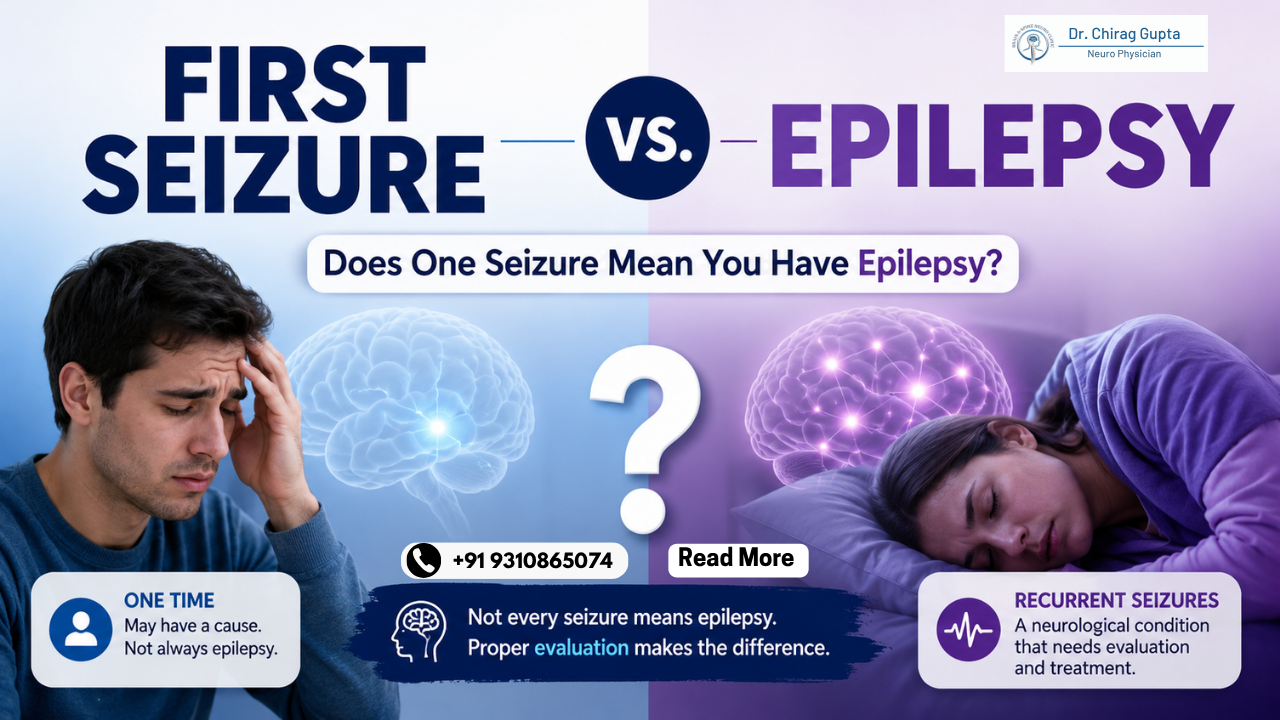
First Seizure vs Epilepsy: Does One Seizure Mean You Have Epilepsy?
A seizure is one of the most frightening medical events a person or their family can witness. The sudden loss of consciousness, uncontrolled movements, and confusion — it leaves everyone in the room shaken. And the question that follows almost immediately.
It is a question that deserves a clear, honest, and medically accurate answer — because the assumption that one seizure automatically equals epilepsy is one of the most common and consequential misconceptions in neurology.
The short answer is: no — a single seizure does not automatically mean epilepsy. But it does mean you need urgent, expert evaluation to understand why it happened, whether it is likely to happen again, and whether treatment is needed right now.
For patients and families across Greater Noida, connecting with the best seizure specialist in Greater Noida after a first seizure event is the most important step you can take — not to receive a frightening diagnosis, but to get clarity, accurate risk assessment, and a personalized plan moving forward.
This blog explains the critical difference between a first seizure and epilepsy, how neurologists evaluate the risk of recurrence, and what modern medicine can offer at every stage.
What Is a Seizure?
A seizure is a sudden, abnormal burst of electrical activity in the brain that temporarily disrupts normal neurological function. Depending on where in the brain this abnormal activity occurs and how widely it spreads, a seizure can produce a wide range of symptoms:
Convulsive seizures — rhythmic jerking of the limbs (tonic-clonic or grand mal seizures), the type most people associate with epilepsy
Absence seizures — brief staring spells with temporary loss of awareness; often mistaken for daydreaming
Focal seizures — abnormal sensations, movements, or emotions in one part of the body, arising from a localised area of the brain
Atonic seizures — sudden loss of muscle tone causing a drop to the ground
Myoclonic seizures — brief, sudden muscle jerks
Not all seizures look the same — and not all seizures are epileptic. Understanding the type and context of the seizure is the starting point for every neurological evaluation.
What Is Epilepsy?
Epilepsy is a chronic neurological disorder defined not by a single seizure, but by a predisposition to recurrent, unprovoked seizures. The internationally accepted definition, established by the International League Against Epilepsy (ILAE), states that epilepsy is diagnosed when a person has:
Two or more unprovoked seizures occurring more than 24 hours apart, OR
One unprovoked seizure with a high risk of recurrence (≥60% over the next 10 years) based on clinical evidence — such as a significant brain lesion, a strongly epileptiform EEG, or a specific epilepsy syndrome.
This distinction is crucial: epilepsy requires evidence of an enduring predisposition to seizures — not just the occurrence of one.
Provoked vs. Unprovoked Seizures: The Critical First Question
The first question any neurologist asks after a seizure is: Was this seizure provoked or unprovoked?
Provoked Seizures
A provoked seizure occurs in direct response to a clear, acute trigger — a transient insult to the brain or body that is now resolved. Common causes of provoked seizures include:
Hypoglycaemia — severe low blood sugar
High fever (febrile seizures in children)
Severe electrolyte imbalance — very low sodium, calcium, or magnesium
Acute alcohol withdrawal is one of the most common causes in adults
Drug toxicity or overdose
Acute head injury
Acute CNS infection — meningitis or encephalitis
Eclampsia during pregnancy
The critical point: provoked seizures do not by themselves indicate epilepsy. The underlying trigger is identified and treated. If the trigger is resolved and does not recur, the seizure risk returns to baseline. The 10-year recurrence risk for a provoked seizure is approximately 20–30% — significantly lower than an unprovoked seizure.
Unprovoked Seizures
An unprovoked seizure occurs without any immediate, reversible trigger. The brain generates the abnormal electrical activity spontaneously, suggesting an underlying structural, genetic, or metabolic predisposition.
After a first unprovoked seizure, the 2-year recurrence risk is approximately 40–50% — meaning roughly half of all people who have one unprovoked seizure will have another within two years.
However, this risk is not the same for everyone. The best epilepsy specialist in Greater Noida will stratify your individual recurrence risk based on several key factors that dramatically influence the probability of a second seizure.
Risk Factors That Increase the Chance of Recurrence After a First Seizure
Neurologists use a combination of clinical history, examination, EEG, and brain imaging to assess individual recurrence risk. Factors that significantly increase the likelihood of having a second seizure include:
1. Abnormal EEG (Electroencephalogram)
An EEG records the electrical activity of the brain. The presence of epileptiform discharges — spike-and-wave complexes or sharp waves — on the EEG after a first seizure approximately doubles the risk of recurrence compared to a normal EEG.
An abnormal EEG is one of the strongest single predictors of epilepsy risk and should be performed in every patient following a first seizure — ideally within 24–48 hours of the event, when abnormalities are most likely to be captured.
2. Structural Brain Abnormality on MRI
If brain MRI reveals a lesion — such as a tumour, cortical dysplasia, hippocampal sclerosis, stroke cavity, or cavernoma — the risk of recurrent seizures is approximately 60–65% over the next 10 years. The presence of a structural cause effectively meets the ILAE threshold for epilepsy diagnosis even after a single seizure.
3. Nocturnal Seizure
Seizures that occur during sleep have a significantly higher recurrence rate than daytime seizures — approximately 70% over 10 years — possibly because sleep-related brain activity is more conducive to seizure propagation.
4. Prior Brain Injury or Neurological Condition
A history of significant head trauma, stroke, CNS infection (meningitis/encephalitis), or a known neurodevelopmental condition substantially increases seizure recurrence risk.
5. Family History of Epilepsy
A first-degree family history of epilepsy suggests a genetic predisposition that elevates both recurrence risk and the likelihood of an underlying epilepsy syndrome.
Does a First Unprovoked Seizure Need to Be Treated?
This is one of the most nuanced decisions in clinical neurology — and one that must be made in partnership between the patient and an experienced specialist.
The general principle: treating after a first seizure reduces the risk of a second seizure but does not change the long-term prognosis of epilepsy.
Studies show that immediate treatment with antiseizure medication (ASM) after a first unprovoked seizure reduces the 2-year recurrence risk from approximately 40% to approximately 25%. However — and this is the critical insight — it does not reduce the eventual probability of achieving seizure remission over 5–10 years. In other words, patients who wait and treat only after a second seizure achieve the same long-term outcomes as those who treat immediately.
Who should be treated after a first unprovoked seizure?
Treatment is generally recommended when:
The EEG shows significant epileptiform abnormalities
Brain MRI shows a structural lesion
The seizure was nocturnal
The individual's lifestyle makes a recurrent seizure particularly dangerous (professional drivers, operating machinery, working at heights)
The patient has a high-risk occupation or has expressed a strong preference for treatment after a fully informed discussion.
Who may reasonably choose to wait?
Patients with a normal EEG, normal MRI, daytime seizure, and low-risk daily activities may reasonably choose watchful waiting — with clear instructions on seizure first aid, safety precautions, and the urgency of returning if a second event occurs.
This decision is not one to be made based on a general blog — it is a deeply personal, clinically informed conversation between patient and neurologist. The best seizure specialist in Greater Noida is equipped to guide this discussion with the accuracy and sensitivity it deserves.
The EEG and MRI: Non-Negotiable After a First Seizure
Every patient who experiences a first seizure — provoked or unprovoked — should have:
EEG (Electroencephalogram)
Should be performed within 24–48 hours of the seizure if possible — epileptiform abnormalities are most detectable in this window.
A routine EEG captures 20–30 minutes of brain activity; if normal, but suspicion remains high, sleep-deprivation EEG or prolonged ambulatory EEG may be requested.
A video-EEG is the gold standard for characterising seizure type and confirming the epileptic nature of events.
MRI Brain (with Epilepsy Protocol)
MRI with specific epilepsy protocol sequences (including FLAIR, T2, and thin-slice hippocampal views) is essential to detect subtle structural abnormalities that a standard brain MRI might miss
CT scan is used in the acute emergency setting to exclude haemorrhage or large lesions — but is insufficient for epilepsy workup; MRI is required.d
Blood Tests
Glucose, electrolytes, calcium, magnesium, renal and liver function — to exclude metabolic causes
Full blood count — to screen for systemic illness
Specific toxicology screen — if drug or alcohol involvement is suspected.
Living After a First Seizure: Practical Safety Guidance
Whether or not antiseizure medication is started, every person who has had a first seizure needs clear safety guidance:
Do not drive — in India, a first seizure requires a mandatory period of seizure freedom (typically 6–12 months) before driving legally; consult your neurologist and the relevant licensing authority
Avoid unprotected heights — construction work, ladders, scaffolding
Do not swim alone — drowning is a disproportionate cause of death in people with seizure disorders
Take showers rather than baths — to reduce drowning risk if a seizure occurs
Inform your employer if your work involves operating heavy machinery or driving
Tell someone you trust about your seizure history — so they can respond appropriately and call for help if needed
Know your triggers — sleep deprivation, alcohol, and stress are common seizure precipitants; avoiding them reduces recurrence risk.
When to Call Emergency Services After a Seizure
Not all seizures require an ambulance — but the following situations do:
The seizure lasts more than 5 minutes (status epilepticus — a medical emergency)
The person does not regain consciousness within 5–10 minutes of the seizure ending
A second seizure occurs within the same episode
The seizure occurs in water
The person is injured during the seizure
It is the person's first-ever seizure, and no cause is known
The person is pregnant or has diabetes
For first-ever seizures, emergency evaluation is always appropriate — even if the person appears to have fully recovered. Calling for help and proceeding to the hospital is never wrong.
Frequently Asked Questions (FAQs)
Q1. Does one seizure automatically mean I have epilepsy?
No — epilepsy requires two or more unprovoked seizures, or one seizure with proven high recurrence risk based on EEG and MRI findings.
Q2. What is the chance of having a second seizure after a first unprovoked event? Approximately 40–50% over two years — but this risk varies significantly based on EEG results, brain MRI, and other individual factors.
Q3. Should I start medication after my first seizure?
Not always — the decision depends on EEG findings, MRI results, seizure type, and lifestyle; consult the best epilepsy specialist in Greater Noida for a personalized assessment.
Q4. Can I drive after a first seizure?
No — a mandatory seizure-free period (typically 6–12 months) is required before resuming driving; your neurologist will advise based on your specific situation.
Q5. How soon should I see a specialist after a first seizure?
Within days — ideally within 24–48 hours for EEG and urgent neurological review with the best seizure specialist in Greater Noida.
Conclusion
A first seizure is alarming — but it is not an automatic epilepsy diagnosis. It is a medical event that demands prompt, expert evaluation to understand its cause, accurately assess the risk of recurrence, and make an informed, personalised decision about whether and how to treat.
Some patients will need antiseizure medication immediately. Others will be safely monitored with careful follow-up. Many will never have a second seizure. But none of these paths can be chosen wisely without the right diagnostic workup — EEG, brain MRI, and a thorough neurological evaluation.
Do not wait, assume the worst, or Google your way to a diagnosis. Connect with the best epilepsy specialist in Greater Noida as soon as possible after any seizure event — and get the clarity, the answers, and the plan you deserve.