
Desk Job and Neck Pain: How Office Work Accelerates Cervical Spondylosis
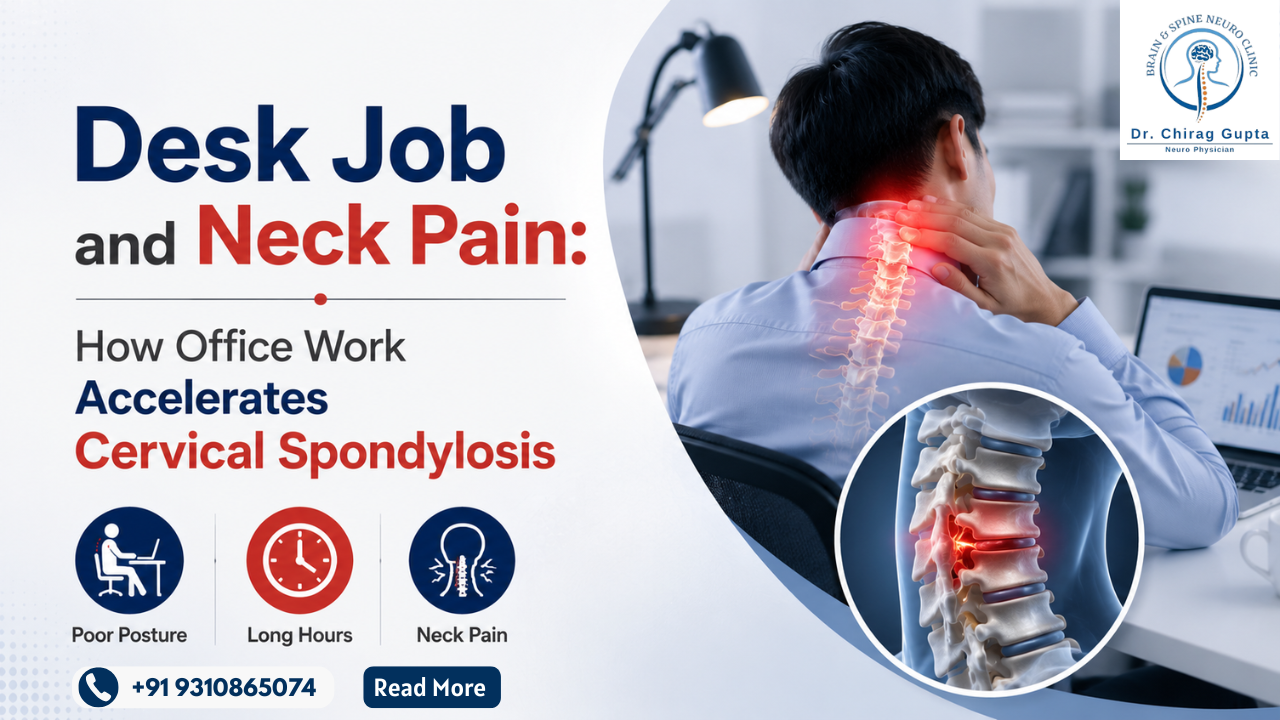
You sit down at your desk at 9 AM. By noon, your neck feels stiff. By 5 PM, there's a dull, persistent ache spreading from the base of your skull down to your shoulders. You tell yourself it's just tiredness. You stretch briefly, go home, sleep it off, and repeat the same cycle the next day.
What you may be brushing off as routine fatigue could actually be the early stages of cervical spondylosis — a condition that is increasingly being diagnosed in working adults in their 30s and 40s, decades earlier than it used to be. Your desk job may be accelerating the wear and tear of your cervical spine far faster than nature intended.
What Is Cervical Spondylosis?
Cervical spondylosis is the age-related degeneration of the discs, joints, and bones in the neck region of the spine (the cervical vertebrae C1–C7). As discs lose their cushioning ability and bone spurs develop, the spinal canal and nerve roots can become compressed — causing pain, stiffness, numbness, and in severe cases, weakness in the arms or hands.
Traditionally, this was considered a condition of people aged 60 and above. Today, neurologists across urban India are seeing it in professionals in their early 30s — and the modern office environment is largely to blame.
How Desk Work Damages Your Cervical Spine
The Forward Head Posture Problem
The average human head weighs around 5–6 kg. When you hold your head in a neutral, upright position, your spine bears that weight comfortably. But for every inch your head tilts forward — as it does when you lean toward a screen — the effective weight on your cervical spine multiplies dramatically. At just 5 cm of forward tilt, the force on your neck can feel equivalent to carrying nearly 20–25 kg.
Office workers spend anywhere from 6 to 10 hours a day in this posture. Over months and years, this relentless pressure compresses the cervical discs, flattens their natural curve, and accelerates degeneration.
Static Posture for Prolonged Periods
Movement is what keeps spinal discs healthy. Discs have no direct blood supply — they receive nutrients through the movement and compression that occurs during normal activity. Sitting in one position for hours deprives discs of this nutrient exchange, causing them to dry out, shrink, and become more vulnerable to injury.
Many IT professionals, data entry operators, and desk workers in tech hubs across Greater Noida sit for 8–10 hours with minimal movement breaks, unknowingly starving their cervical discs.
The Role of Screens, Phones, and Poor Ergonomics
Your monitor height matters enormously. A screen placed too low forces your neck into a downward angle for hours. A screen too far away makes you crane forward. Most office desks are not set up with spinal health in mind.
Add to this the habit of cradling a phone between your ear and shoulder during calls, hunching over a laptop at a cafe table, or looking down at a smartphone for hours after work — and your cervical spine is under assault virtually every waking hour.
The Best Neuro Physician in Greater Noida frequently sees patients from Sector 27, Alpha I, and Pari Chowk who report that their neck pain began subtly with screen-related stiffness before progressing into radiating pain and tingling in the fingers — classic signs of cervical nerve compression.
Warning Signs You Must Not Ignore
Cervical spondylosis doesn't announce itself loudly at first. Watch for:
- Persistent stiffness in the neck, especially in the morning
- Headaches originating from the base of the skull
- Tingling, numbness, or weakness in the arms, hands, or fingers
- A grinding or clicking sensation when turning your head
- Loss of balance or difficulty with fine motor tasks in advanced cases
If you experience any combination of these symptoms regularly, do not self-medicate or assume it will resolve on its own.
Prevention: What Office Workers Must Do Daily
1. Fix Your Workstation First, your monitor should be at eye level, roughly an arm's length away. Your chair should support the natural curve of your lower back, with feet flat on the floor. Invest in an ergonomic setup — it is far cheaper than treating spondylosis.
2. The 30-20 Rule: For every 30 minutes of sitting, take a 2-minute movement break. Stand, walk to the water cooler, roll your shoulders, and gently turn your head side to side. This restores nutrient flow to your discs.
3. Chin Tucks — The Most Underrated Exercise Gently draw your chin straight backward (not downward) to create a "double chin." Hold for 5 seconds. Repeat 10 times. This simple movement strengthens the deep cervical flexors and actively counteracts forward head posture.
4. Strengthen Your Upper Back. Weak upper back muscles force your neck to compensate, worsening forward head posture. Exercises like rows, face pulls, and scapular squeezes build the foundation your cervical spine needs.
Professionals working in IT parks and corporate offices across Greater Noida should consider consulting the Best Neuro Physician in Greater Noida for a posture and neurological assessment before symptoms become severe.
When to See a Neurologist
Most people wait too long. They try home remedies, neck pillows, and painkillers for months before seeking a proper diagnosis. By then, disc degeneration may have already progressed significantly.
You should see a neurologist if neck pain is persistent beyond 2–3 weeks, if it radiates into your arms, if you feel unexplained weakness in your grip, or if headaches are becoming more frequent alongside neck stiffness.
Early diagnosis through MRI or X-ray can reveal the extent of degeneration and guide a targeted treatment plan — which may include physiotherapy, medication, nerve blocks, or lifestyle modification, depending on the stage.
Medical Perspective: Why Greater Noida Is Seeing More Cases
Greater Noida has emerged as a major IT and corporate hub over the last decade. With a large workforce employed in sedentary, screen-heavy jobs across sectors like Knowledge Park, Techzone, and Sector 62, the incidence of early-onset cervical spondylosis has risen sharply. The Best Neuro Physician in Greater Noida reports a significant increase in patients under 40 presenting with cervical disc prolapse and nerve compression — conditions once reserved for the elderly.
The lifestyle factors compound each other: long commutes, stress, poor sleep posture on thick pillows, reduced physical activity, and 10-hour workdays create a perfect storm for spinal deterioration.
Conclusion: Your Neck Is Paying the Price of Your Career
Cervical spondylosis is not inevitable — but it is increasingly common among people who spend most of their waking hours hunched over a desk. The damage accumulates over the years silently, and by the time pain becomes undeniable, significant degeneration may already be present.
Take your neck health seriously today. Adjust your workstation, move more, strengthen your upper back, and most importantly — listen to your body's early warning signs. If symptoms persist, consult the Best Neuro Physician in Greater Noida for a comprehensive neurological evaluation and a treatment plan designed to protect your spine for the long term.
Your career can wait five minutes for a posture break. Your cervical spine cannot wait years for treatment.
FAQs
Q1. Can cervical spondylosis be reversed?
It cannot be fully reversed, but symptoms can be significantly managed with physiotherapy, lifestyle changes, and appropriate medical treatment.
Q2. Is neck cracking a sign of cervical spondylosis?
Occasional neck cracking is common, but frequent grinding or clicking with pain or stiffness should be evaluated by a neurologist.
Q3. Can cervical spondylosis cause headaches?
Yes. Compression of cervical nerves and tight neck muscles is a common cause of occipital headaches that radiate from the neck to the head.
Q4. What is the best sleeping position for cervical spondylosis?
Sleeping on your back with a cervical support pillow, or on your side with the pillow keeping your neck aligned with your spine, is generally recommended.
Q5. At what age can cervical spondylosis begin in desk workers?
Due to prolonged screen use and poor posture, symptoms are now commonly seen in desk workers as early as their late 20s and early 30s.